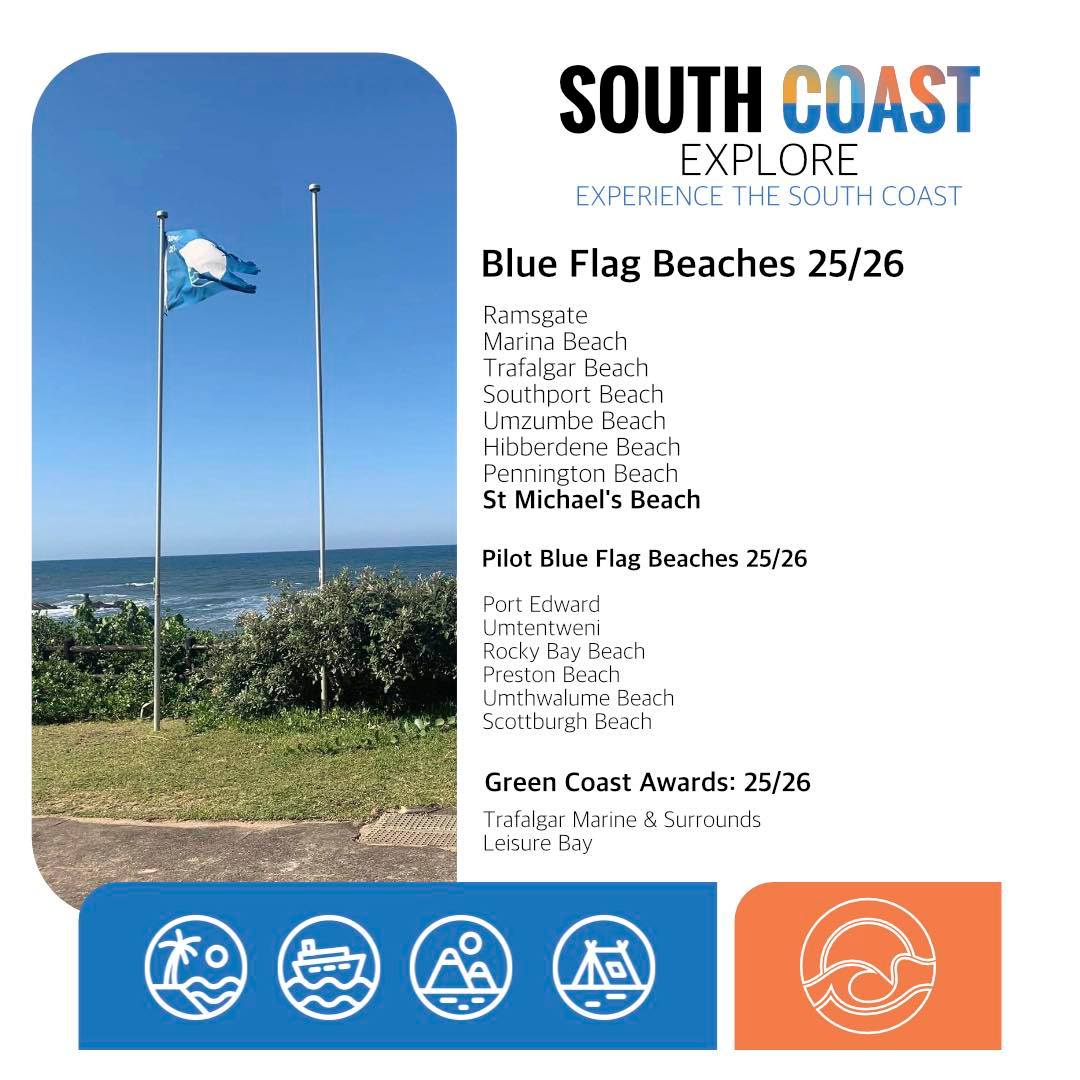
A total of 97 certifications, recognising 50 full status Blue Flag beaches, 20 Pilot sites, 5 Marinas, 7 Boats, and 15 Green Coast sites.
Port Alfred, Eastern Cape, South Africa – 31 October 2025: South Africa has officially unveiled its 2025/26 Blue Flag and Green Coast sites, celebrating excellence in coastal management, environmental education, and sustainable tourism.
Announced by WESSA (the Wildlife and Environment Society of South Africa), the national operator for the global Blue Flag eco-label in South Africa, this year’s awards recognise a combined total of seventy beaches, including pilot sites, five marinas, and seven tourism boats for meeting international standards of quality, safety, and environmental responsibility.
The celebration, co-hosted by the Ndlambe Municipality at the Royal St. Alfred Hotel in Port Alfred, also honoured the Green Coast Programme, WESSA’s local initiative that enables coastal communities and municipalities to protect, restore, and showcase natural heritage sites that fall outside the traditional Blue Flag framework.
“We are proud to host this celebration in our beautiful coastal town,” says Ndlambe Madam Mayor, Khululwa Ncamiso in her welcome address. “It’s a place recognised not only for its natural beauty, but for the Blue Flag status we work hard to uphold year after year.”
As WESSA marks 99 years of People Caring for the Earth, the Blue Flag and Green Coast awards remain cornerstones of the organisation’s mission to foster environmental stewardship across South Africa’s 3,000 km coastline. Mike Denison, WESSA’s Senior Manager for the Coastal Programme reflected on the dual significance of the occasion: the 25th anniversary of Blue Flag in South Africa and 20 years of partnership with Ndlambe Municipality, one of the country’s longest-standing Blue Flag champions.
“For us, Blue Flag represents true service delivery, care for our environment, care for our people, and care for the visitors who come to enjoy our coastline. Our team is passionate and committed to protecting this achievement. As leadership, we will do everything possible to ensure that our Blue Flag status is never lost under our watch,” adds Ncamiso.
Blue Flag global standards, local action
Since its introduction to South Africa in 2001, the Blue Flag Programme has grown to become one of the most recognised international eco-labels for beaches, marinas, and sustainable tourism boats. The programme represents a collaboration between local municipalities, tourism entities, and community volunteers, supported by the Department of Forestry, Fisheries, and the Environment (DFFE).
“Our Blue Flag and Green Coast programmes are more than symbols, they’re a promise. A promise of care, of commitment, of collaboration, of clean water, safe swimming, well-managed beaches, and a world-class coastal experience that celebrates South Africa’s natural and cultural heritage,” says WESSA CEO, Cindy-Lee Cloete, during her address. “Behind every flag is a team of people who work tirelessly to meet all the global standard criteria, in the face of shifting tides, both literal and figurative. Collaboration is what keeps these programmes strong; it’s what allows us to listen, adapt, and ensure that our Blue Flag beaches and Green Coast sites belong to everyone,” Cloete adds.
Five Blue Flag recognition awards
Long-term Blue Flag achievers were honoured for their continued commitment to coastal excellence. Hibberdene Beach received recognition for maintaining Blue Flag standards for 10 consecutive years, while Witsand and Umzumbe Beach were celebrated for 15 years of consistent achievement. Leading the way, Kelly’s Beach and Lappiesbaai proudly marked 20 years of Blue Flag certification. These milestones reflect decades of environmental stewardship, community partnership, and dedication to keeping South Africa’s coastlines clean, safe, and sustainable.
70 Blue Flag beaches certified for the 2025/6 season (50 Full status and 20 Pilot)
| Municipality | Full Sites | Pilot Sites | Total Blue Flag Sites (2025/26) |
| City of Cape Town | 8 | 0 | 8 |
| Overstrand | 2 | 3 | 5 |
| Cape Agulhas | 1 | 0 | 1 |
| Hessequa | 6 | 0 | 6 |
| Mossel Bay | 4 | 3 | 7 |
| Bitou | 6 | 0 | 6 |
| Nelson Mandela Bay | 3 | 2 | 5 |
| Kouga | 2 | 0 | 2 |
| George | 3 | 1 | 4 |
| Ndlambe | 3 | 0 | 3 |
| KwaDukuza | 4 | 0 | 4 |
| Ray Nkonyeni | 7 | 2 | 9 |
| Umdoni | 1 | 4 | 5 |
| Buffalo City Metro | 0 | 2 | 2 |
| Mandeni | 0 | 2 | 2 |
| Port Nolloth *1st in Northern Cape | 0 | 1 | 1 |
- The seven tourism boats awarded Blue Flag status for the 2025/26 season, include vessels operated by Marine Dynamics Shark & Whale Tours (Slashfin, Dreamcatcher, Whale Whisperer), White Shark Diving Company (White Shark, Shark Bait), and Offshore Adventures (Robberg Express, Oceanic). They are recognised for excellence in environmental education, management, safety, and responsible tourism.
- Five marinas achieved Full Blue Flag status for maintaining world-class standards in water quality, safety, environmental management, and community engagement. These are the Royal Alfred Marina, Thesen Harbour Town Marina, Thesen Islands Homeowners Marina, V & A Waterfront, and Club Mykonos Marina.
These achievements affirm South Africa’s position as a global leader in coastal management, with municipalities continuing to invest in public education, water quality, safety standards, and inclusive access.
Leading this long-standing success is Ndlambe Municipality, now marking 20 consecutive years as a Blue Flag champion. Deputy Director, Community Protection Services at the municipality, Fanie Fouche, shares, “Nothing is impossible when you have a committed team and a shared purpose. Through floods, storms, and shifting tides, our community has kept the Blue Flag flying for 20 years, proving that dedication and teamwork make sustainable coastal management possible. Our Blue Flag journey has created thousands of job opportunities, strengthened local pride, and inspired a generation of young environmental stewards. For us, it’s never just about the beach, it’s about people, purpose, and progress.”
WESSA’s Green Coast network sees twofold growth
The Green Coast Programme, developed by WESSA to complement Blue Flag, celebrates natural, less-developed coastal areas that uphold environmental integrity and promote nature-based tourism. Denison describes it as “a home-grown innovation, designed to reward conservation excellence where communities are custodians of their coastline.”
The Green Coast network has more than doubled in size this season, with new municipalities and community organisations joining to implement improved coastal management and eco-tourism initiatives.
Speaking on galvanising Green Coast communities, Dr. Deborah Robertson-Andersson representing the Kei Mouth and Morgan Bay sites in the Eastern Cape shares, “We started as four people walking our coastline during lockdown and today, we are over four hundred residents working together under the Green Coast umbrella. When people stop complaining and start acting, everything changes. When a crisis hits, our community knows who to call, how to act, and how to solve problems together, that is what true coastal stewardship looks like. With every report we submit, every photograph and every data point tell the story of ordinary people protecting extraordinary places. That is the spirit of Green Coast, citizen science in action.”
15 Green Coast sites received certification:
| Implementing Partners | Green Coast Sites (as listed on certificates) |
| City of Cape Town | Blaauwberg Nature Reserve |
| Bitou Municipality & Nature’s Valley Trust | Nature’s Valley |
| CapeNature | Walker Bay |
| Knysna Municipality & The Strandloper Project | Swartvlei Beach |
| Mbhashe Local Municipality | Qatywa Beach, Lubanzi Beach, Cwebe Beach |
| Great Kei Local Municipality & Chrysalis Training | Chintsa Beach, Morgan Bay, Kei Mouth |
| Ray Nkonyeni Municipality & Mpenjati Conservancy, Leisure Bay Conservancy | Leisure Bay Conservancy, Trafalgar Marine Reserve and Surrounds |
| Kouga Municipality & The JBay Surf Alliance | J Bay Supertubes, J Bay Paradise Beach |
| George Local Municipality | Gwaing Beach |
Turning awareness into action
The event also spotlighted WESSA’s Stop the Strangle action campaign, an initiative combating marine pollution and ghost fishing gear. “Every year, around 640,000 tons of discarded fishing gear enter our oceans, staying there for up to 25 years,” Denison noted. “It’s a devastating cycle that costs over 100,000 marine mammals and more than a million seabirds their lives each year.”
This call to action was echoed by Marine Conservationist, Dickie Chivell, whose fieldwork in marine entanglement rescue embodies the spirit of direct action and awareness. “Marine pollution is one of the biggest killers of our marine animals and these are horrific deaths. I’ve seen mothers carrying their dead calves, and seals slowly choking to death. That’s why every fishing line bin, every cleanup, every act of awareness matters.” Chivell in his closing remarks adds, “We are not just Marine Dynamics, or DFFE, or WESSA we are what WESSA has been saying for 99 years: people caring for the Earth.” Chivell’s message underscored the urgency of cross-sector collaboration to combat marine pollution and highlighted the role of every citizen in reducing waste entering the ocean.
Ryan Peter, the Director of Coastal Development and Coordination within the Oceans and Coasts Branch of the DFFE, in his presentation, notes that, “Coastal management is larger than any one of us, it’s a shared responsibility that connects municipalities, communities, and national government. Together we are building the systems, data, and partnerships that make South Africa a leader on the African continent in implementing integrated coastal management.”
Celebrating the collective footprint
“We thank WESSA and all partners for continuing to bring these initiatives to our shores, they raise our flag high and remind us of the value of working together,” notes Ndlambe Madam Mayor, Khululwa Ncamiso.
Closing the ceremony, Denison reminded attendees that small actions, when joined together, create a movement, “As individuals, we may not change the world, but we can make a hell of a difference where we live. When we join those smaller footprints together, it becomes an enormous investment in caring for our Earth.”
ENDS